








Water, Design and a new Embassy: A brief summary of last 48 hours in Planning World


Sometimes, being in planning feels a bit like standing at a bus stop. You wait what feels like an age* for a major piece of news to come along and then three arrive at once!
This blog is an attempt to tackle some of the big events of the last forty-eight hours, namely:
- DEFRA’s release of the New Vision for Water White Paper
- The Chinese Embassy decision; and
- MHCLG’s consultation on a new Design & Placemaking PPG.
So I suppose we had better crack on before something else happens!
A New Vision for Water
Given the events of the last few weeks, Defra’s decision to launch the “A New Vision for Water” white paper yesterday felt timely.
The White Paper is only fifty two pages long but it sets out a roadmap for the root and branch reform of the regulation, operation and management of the water environment in England. There is a lot to unpack in the proposals and they probably deserve a lot more attention than I intend to give them.
That said, this is first and foremost a planning blog. As such, I have summarised some of the key planning-related elements of the white paper below:
- Whilst not expressly stated in the white paper itself, it looks as if the new strategic planning authorities are likely to have a key role in the “regional water planning” function that the white paper proposes for England.
- Water companies are to become consultation bodies in the ‘LURA’ designed 30-month local plan system;
- In addition, the government is considering making water companies statutory consultees on planning applications
- DEFRA and MHCLG are working together to “ensure the right to connect for water supply and to the sewerage system supports and enables the government’s housing delivery objectives” but the white paper doesn’t provide that many clues to precisely what is meant by this.
- In terms building water infrastructure itself, MHCLG intend to review Permitted Development Rights for water companies in England and update the National Policy Statements for water resources and wastewater projects;
- And finally for readers of a more environmental bent, the White Paper also mentions amending environmental permitting regulations on a number of occasions – both in relation to water abstraction, but also in terms of agricultural pollution.
The White Paper needs to be considered in the context of Part 3 of the Planning & Infrastructure Act, and the Environmental Delivery Plans currently being drawn up, the first tranche of which are expected to focus on addressing nutrient pollution across England.
As such, I was a little surprised that the White Paper did not make more of a splash when it was launched, but I am going to put that down to the second piece of news in this blog… which was released on the same day.
The Chinese Embassy Decision
Also on Tuesday, MHCLG published the called-in decision on the Chinese Embassy application at Royal Mint Court. This decision has attracted a lot of attention and commentary, so I am not going to spend a great deal of time on it.
I do, however, want to draw attention to the following analysis on the extent to which the identity of the potential occupier of a development can constitute a material planning consideration, which is interesting (and in my view correct):
Sections from Decision Letter
“10. The Secretary of State notes that the applications are not being pursued on the basis of a personal permission (IR13.22 13.24); however, the intention is that the premises shall be occupied as an embassy by the People’s Republic of China (PRC). For the reasons given at IR13.25-13.30, he agrees that any ethical or similar objections to the provision of an embassy for a specific country cannot be a material planning consideration (IR13.27). He further agrees that PRC is not a material consideration in itself, and nor are any moral, ethical or cultural considerations which may or may not arise from the PRC as occupants (IR13.29). For the same reasons, the Secretary of State considers that the same is true of general (as opposed to site specific – see paragraph 11 below) concerns around national security arising from the identity of the proposed occupants. The Secretary of State agrees with the Inspector’s overall approach to the identity of the proposed occupants (IR13.29). He notes the Inspector’s comments at IR13.93 and considers that non-site specific national security concerns would be dealt with by other means, via other legal processes and by various agencies, including under the Vienna Conventions (see footnote 9 below), and that this is not something that can be controlled through the planning system.
11. However, the Secretary of State further notes that a number of site-specific issues related to the proposed occupants have been raised (IR13.25.1-13.25.5), including matters related to security. This includes concerns relating to the proximity of telecommunications cables at the Wapping Telephone Exchange (IR10.95 and IR10.296). He considers that site-specific matters linked to the identity of the proposed occupants, including in relation to national security, are capable of being material planning considerations, and these matters are addressed below. Insofar as they are material to the planning case before him, the Secretary of State has taken site-specific national security considerations into account in reaching his decision.”
Sections from the Inspector’s Report
13.26 Within the land use planning regime, the broad principle that planning permission runs with the land clearly must stand; the applications are for an embassy use and should be judged on a ‘nation-neutral’ basis in accordance with the development plan. The Vienna Conventions are also an important material consideration in terms of the duties it places on facilitating premises [6.47-6.50].
13.27 In this regard, any ethical or similar objection to the provision of an embassy for a specific country cannot be a material planning consideration. It would not be lawful to refuse permission simply because it would be for a Chinese Embassy (my emphasis). The same would hold for any other specific country seeking an embassy use through the planning system.
…..
13.29 A clear line can be drawn; PRC is not a material consideration in itself, nor are any ethical/moral considerations which may or may not arise from the PRC as occupants. But the detailed proposals and site-specific planning evidence relating to the effects arising from the proposed occupants and the main considerations I have identified are relevant. This goes both to assessment of harm and benefits, as well as to the assessment of conditions and recommendations.
Design and Placemaking PPG Consultation
And last, but by no means least, earlier today MHCLG launched a consultation on its new Design and Placemaking PPG. The new PPG will according to the press release, will set “a clear benchmark for well-designed neighbourhoods, ensuring new developments are well-connected to local shops and services”
The draft PPG is divided into three main parts.
- Section 1 sets out the seven features of well‑designed places, which have been snappily titled “liveability, climate, nature, movement, built form, public space and identity”.
- Section 2 is focussed on design quality in the planning process; and
- Section 3 is all about creating effective design codes.
Interestingly, the draft PPG also contains an entire section setting out how the PPG is intended to relate to the draft NPPF, when adopted, that emphasises that it is intended to have a subordinate or supporting role. This is neatly encapsulated in a diagram on page 6 (copy below).
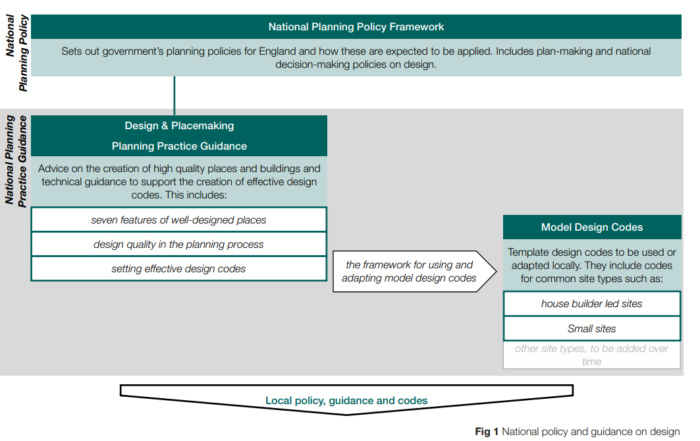
This aligns quite neatly with the commentary in the consulation draft NPPF (at paragraph 13) which states that:
“National planning policy is supported by a suite of planning practice guidance, the purpose of which is to support the implementation of national planning policy. The government intends this to play an important but supporting role to national planning policy and its status should be regarded in that light.”
The consultation runs until 11:45pm on 10 March 2026.
The press release can be found here and the consultation here.
*but is probably rarely more than a fortnight, let’s face it.
Further Thoughts by Nicola Gooch


Christmas Presents: The Planning & Infrastructure Act becomes Law & Other News

The Holly & MHCLG: Consultation on Revised NPPF Opens – along with a raft of other reforms
The opinions in this article are the author’s own, and the content of this article is for general information only. It is not, and should not be taken as, legal advice. If you require any further information in relation to this article, please contact the author in the first instance. Law covered as at 21 January 2026.